


Choosing an MBA specialisation is easier when you understand what you will study, what the eligibility requirements are, and where the degree can take you professionally. An MBA in HR Management combines business management fundamentals with specialised knowledge of recruitment, employee development, performance, talent management and organisational strategy.
For students who enjoy working with people but also want to understand how businesses operate, Human Resource Management can offer a practical management career path. This guide covers the MBA HR course, eligibility, subjects, admission process, skills, career opportunities and future scope.
What Is an MBA in HR Management?

An MBA in Human Resource Management is a postgraduate management programme focused on managing people and workforce-related functions within an organisation. Along with core business subjects, students learn how organisations recruit, develop, evaluate and retain employees.
The course typically covers areas such as organisational behaviour, talent acquisition, training and development, performance management, compensation, employee relations and strategic HR.
Unlike a general MBA, which provides broader exposure to several business functions, an MBA in HR gives greater depth to people management and organisational development.
MBA in HR Management Course Details
| Course Detail | Information |
| Degree | Master of Business Administration |
| Specialisation | Human Resource Management |
| Level | Postgraduate |
| Duration | Generally 2 years |
| Structure | Usually 4 semesters for a full-time programme |
| Main Focus | HR management + business management |
| Key Areas | Recruitment, talent, training, performance, compensation and employee relations |
| Career Areas | Recruitment, training and development, people analytics, employee relations, and strategic HR |
A two-year structure is common among full-time MBA HR programmes in India, although the curriculum and delivery format can differ between institutions.
MBA in HR Management Subjects
The exact syllabus varies by university, but students commonly encounter subjects such as:
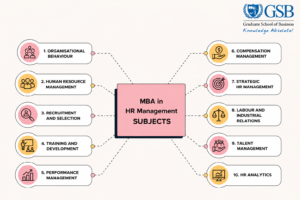
Students also study broader management areas such as finance, marketing, operations, economics and business research.
MBA in HR Management Eligibility
For most MBA programmes, candidates need a bachelor’s degree from a recognised institution. The minimum percentage, accepted degree formats and entrance requirements depend on the college.
For example, current MBA HR programmes at different institutions specify different graduation marks and selection criteria, which is why students should always check the official admission rules of the college they are applying to.
Students from different academic backgrounds can generally pursue an MBA in HR if they meet the institution’s requirements. A commerce, management, science, arts or other undergraduate background does not automatically prevent someone from choosing HR.
Work experience is also not universally required for a regular full-time MBA. Some programmes may consider or require experience, particularly for executive or specialised formats.
Before applying, students can also verify the recognition status of higher-education institutions through the University Grants Commission (UGC).
MBA in HR Management Admission Process
The admission process depends on the institution, but it commonly follows these steps:
Check eligibility → Submit application → Appear for entrance examination, if required → Selection process → Final admission
Depending on the college, selection may consider entrance-test scores, academic performance, interviews, group discussions or other assessment components. Some institutions accept national or state-level management entrance examinations, while others have their own admission process.
Skills You Develop During an MBA in HR
An MBA HR programme is not only about learning HR policies. It can help students develop a combination of people, managerial and analytical skills.
Key skills include:
- Communication and active listening
- Leadership and team management
- Recruitment and talent acquisition
- Negotiation and conflict management
- Employee engagement
- Performance management
- Problem-solving and decision-making
- HR analytics
- Strategic thinking
The importance of combining human and technological capabilities is also increasing. The World Economic Forum’s Future of Jobs report 2025 identifies leadership and social influence, talent management, analytical thinking, technological literacy, empathy and active listening among important workforce skills.
Career Scope After MBA in HR Management
An MBA in HR can lead to opportunities across industries because organisations of different sizes need people who can manage hiring, workforce development, employee relations and organisational performance.
Popular Job Roles After MBA HR
| Job Role | Main Responsibility |
| HR Executive | Supports day-to-day HR activities |
| Talent Acquisition Specialist | Handles recruitment and hiring |
| HR Manager | Oversees HR functions and policies |
| Learning & Development Specialist | Oversees employee learning programs |
| Compensation & Benefits Specialist | Oversees compensation programs |
| HR Business Partner | Connects HR strategy with business objectives |
| HR Analytics Professional | Uses workforce data for HR decisions |
Graduates may also explore organisational development, employee relations, recruitment management, payroll, workforce planning and HR consulting.
Industries Hiring MBA HR Graduates
HR professionals are required across sectors such as:
- IT and technology
- Banking and financial services
- Manufacturing
- Consulting
- Healthcare
- Retail and e-commerce
- FMCG
- Education
- Hospitality
MBA in HR Management Salary in India
There is no single salary figure that applies to every MBA HR graduate. Compensation can vary significantly according to job role, experience, industry, location, employer, skills and previous internships or work experience.
An entry-level HR professional may begin in roles such as HR Executive, Recruiter or HR Associate, while experience can open pathways towards HR Manager, HR Business Partner, Talent Management or senior strategic HR positions.
For this reason, students should evaluate career growth and role quality alongside starting salary rather than choosing a programme only on the basis of an advertised salary figure.
Future Scope of MBA in HR Management
HR is becoming increasingly connected with technology and business strategy. Organisations are using workforce data to understand hiring, retention, performance and employee trends, while HR professionals are also expected to understand digital tools and changing workplace practices.
Areas such as HR analytics, AI-enabled HR processes, talent management, employee experience and strategic workforce planning are therefore becoming increasingly relevant.
IIM Kozhikode’s current HR Management and Analytics programme, for example, highlights the use of data and analytics to support HR and management decisions.
The broader employment landscape is changing too. The World Economic Forum reports that employers expect substantial changes in workforce skills through 2030, with AI and big data, technological literacy, leadership, analytical thinking and talent management gaining importance.
Explore: Best MBA Career Opportunities Beyond Corporate Jobs
Is MBA in HR Management a Good Career Choice?
MBA HR can be a suitable option for students who enjoy working with people, communication, leadership and organisational problem-solving. It may also suit those who want a management career that combines human interaction with business decision-making.
However, students who strongly prefer purely technical, finance-focused or quantitative careers may find another MBA specialisation more aligned with their interests.
The best choice depends on your strengths, career goals and the type of work you want to do after graduation.
MBA in HR Management at GSB College
At Graduate School of Business (GSB), Indore, the MBA programme is structured as a two-year, four-semester postgraduate programme, with HR available as a specialisation. GSB’s published programme information includes Human Resource Management among its management specialisations and highlights practical learning, industry exposure and career-oriented development.
GSB also lists HR-focused learning opportunities such as HR Analytics, Recruitment Analytics, Virtual HRM, organisational development and change management, giving students opportunities to explore both traditional and emerging areas of human resource management.
Also explore some of the best MBA Colleges in Indore with In-Demand Specialization
FAQs About MBA in HR Management
What is an MBA in HR Management?
It is a postgraduate management programme that combines business administration with specialised study of recruitment, talent management, employee development, performance, compensation and organisational strategy.
Is MBA in HR a 2-year course?
A full-time MBA in HR is generally a two-year postgraduate programme divided into four semesters, although the structure can vary by institution.
What is the eligibility for MBA in HR?
Generally, candidates need a bachelor’s degree from a recognised institution. Minimum marks and entrance requirements vary between colleges.
Can I pursue MBA HR after BBA?
Yes. BBA graduates can generally pursue MBA HR if they meet the eligibility requirements of their chosen institution.
Can I pursue MBA HR after B.Com?
Yes. B.Com graduates can also pursue MBA HR and may benefit from their existing understanding of business and organisational fundamentals.
What subjects are taught in MBA HR?
Common subjects include organisational behaviour, human resource management, recruitment, training and development, performance management, compensation, strategic HR and HR analytics.
What jobs can I get after MBA in HR?
Career options include HR Executive, Talent Acquisition Specialist, HR Manager, Learning & Development Specialist, HR Business Partner and HR Analytics Professional.
Is MBA in HR a good career option?
It can be a good option for students interested in people management, organisational behaviour, leadership and business strategy. Career outcomes depend on skills, experience, institution and industry.
Final Takeaway
An MBA in HR Management combines management education with specialised knowledge of people and organisational development. From recruitment and employee engagement to HR analytics and strategic workforce planning, the field now extends well beyond traditional HR administration.
Before choosing a programme, compare its eligibility requirements, curriculum, practical exposure, industry interaction and career support. Most importantly, consider whether the nature of HR work matches your interests and long-term career goals.

