



Choosing the right course after 12th is a crucial step that shapes a student’s career path.. With changing business trends, digital transformation, and increasing demand for management professionals. In recent years, BBA has gained massive popularity among students. As businesses expand, startups grow, and management skills become essential across industries, courses like BBA (Bachelor of Business Administration) are more relevant than ever.
BBA is not just a degree it is a career-focused management program that builds strong foundations in business administration, leadership, marketing, finance, human resources, and entrepreneurship. Whether you want to enter the corporate world early or plan higher studies like MBA, PGDM, or specialized management courses after 12th, BBA offers a flexible and future-ready career pathway.

In this detailed guide, you will learn everything about BBA course details 2026, including eligibility, fees, syllabus, career scope, salary expectations, and trending specializations.
What Is BBA? Course Details & Key Highlights
BBA (Bachelor of Business Administration) is a three-year undergraduate degree program divided into six semesters. It focuses on developing strong fundamentals in business management along with practical exposure to real-world corporate and organizational practices.
Unlike traditional academic degrees, BBA emphasizes practical learning, case studies, presentations, projects, and industry interaction, making it ideal for students who want to build a management or business-oriented career soon after graduation.
| Particulars | Details |
| Full Form | Bachelor of Business Administration |
| Course Level | Graduation |
| Course Duration | 3 Years |
| BBA Eligibility | Minimum 50% marks in 10+2 from a recognized board (any stream; some colleges prefer Maths/Commerce) |
| Examination Type | Semester-wise |
| Admission Process | Merit-based or Entrance Exam-based (CUET, SET, IPMAT, or university-level exams) |
| Average Salary After BBA Degree | INR 5–8 LPA (varies by specialization & skills) |
| Curriculum / Subjects | Principles of Management, Business Economics, Financial Accounting, Marketing Management, Human Resource Management, Business Law, Operations Management, Business Statistics, Entrepreneurship, and Organizational Behavior |
Why BBA Is becoming Smart Choice Nowadays
In today’s competitive economy, organizations need professionals with strong knowledge of business operations, management, marketing, and finance, making BBA a highly relevant course in 2026.
BBA is considered a smart career choice because:
- It builds a strong foundation in management and leadership
- It offers early exposure to corporate culture
- It is suitable for Commerce, Arts, and Science students
- It opens doors to jobs as well as higher studies like MBA
- It supports entrepreneurship and startup careers

As per UGC and national education priorities, skill-oriented education plays a key role in preparing India’s future workforce.
BBA Syllabus 2026: What You Will Study
Below is a general semester-wise BBA syllabus. Subjects may vary slightly by institution.
1st Semester
- Principles of Management
- Business Economics
- Financial Accounting
- Business Communication
2nd Semester
- Organizational Behavior
- Business Mathematics
- Marketing Fundamentals
- Environmental Studies
3rd Semester
- Human Resource Management
- Cost Accounting
- Business Law
- Research Methodology
4th Semester
- Financial Management
- Operations Management
- Management Information Systems
- Elective I
5th Semester
- Strategic Management
- Entrepreneurship Development
- Digital Marketing / Business Analytics
- Elective II
6th Semester
- International Business
- Project Work / Internship
- Electives (Finance / HR / Marketing)
BBA Admission 2026: Eligibility Criteria
Basic Requirementsc
To be eligible for BBA admission in 2026, most colleges require:
✔ Completion of Class 12 from a recognized board (CBSE / ISC / State Boards)
✔ Minimum aggregate marks between 45%–50% (varies by institution)
✔ Students from any stream (Commerce, Arts, Science) are eligible
Entrance Exams
Some colleges admit students based on merit (Class 12 marks), while others may conduct entrance tests or interviews. Students should always check official admission guidelines for 2026.
BBA Basic Fees Structure
BBA fees depend on the type of institution.
| College Type | Approx. Annual Fees (₹) |
| Government / State College | 20,000 – 60,000 |
| Private Colleges | 60,000 – 1,50,000 |
| Career-Oriented Institutes | 80,000 – 2,00,000 |
Tip: Always check the official fee structure for 2026 before applying.
Career Options After BBA in 2026
A Bachelor of Business Administration (BBA) degree opens up a wide range of career opportunities in management, corporate, finance, marketing, HR, and entrepreneurship. After completing BBA, students can enter the job market directly or pursue higher studies for advanced roles.
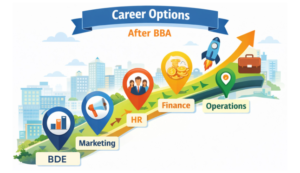
Here are the top career options you can pursue after BBA:
1. Business Development Executive / Manager
Business Development professionals focus on growing a company by identifying new business opportunities, partnerships, and markets.
Key Responsibilities:
• Identifying potential clients and business opportunities
• Building strong relationships with customers
• Preparing business proposals and closing deals
Skills Required:
• Communication and negotiation skills
• Market research and strategic thinking
• Presentation and sales skills
Specializations: Sales Manager, Growth Manager, Relationship Manager
Salary Range: ₹3 LPA to ₹10 LPA (based on experience and performance)
2. Marketing Executive / Digital Marketer
Marketing professionals promote products or services and help brands reach their target audience through offline and digital channels.
Key Responsibilities:
• Planning and executing marketing campaigns
• Managing social media and digital platforms
• Conducting market research and competitor analysis
Skills Required:
• Creativity and communication skills
• Knowledge of digital marketing tools (SEO, SMM, Ads)
• Analytical and content strategy skills
Specializations: Digital Marketing, Brand Management, Content Marketing
Salary Range: ₹3 LPA to ₹8 LPA (can increase with skills and certifications)
3. Human Resource (HR) Executive
HR professionals manage hiring, employee engagement, training programs, and workplace regulations.
Key Responsibilities:
• Hiring and onboarding employees
• Managing employee records and performance
• Handling payroll, compliance, and training programs
Skills Required:
• Communication and interpersonal skills
• Organizational and problem-solving abilities
• Knowledge of labor laws and HR practices
Salary Range: ₹2.5 LPA to ₹8 LPA (depends on organization size)
4. Financial Analyst / Accounts Executive
This role involves managing financial data, budgets, and financial planning for organizations.
Key Responsibilities:
• Preparing financial reports and statements
• Analysing company budgets and expenses
• Assisting in investment and financial decisions
Skills Required:
• Strong numerical and analytical skills
• Knowledge of accounting and finance concepts
• Proficiency in Excel and financial tools
Salary Range: ₹4 LPA to ₹12 LPA (higher with experience and certifications)
5. Operations Manager
Operations Managers ensure smooth day-to-day business activities and improve operational efficiency.
Key Responsibilities:
• Managing supply chain and logistics
• Monitoring business processes and productivity
• Coordinating with different departments
Skills Required:
• Leadership and decision-making skills
• Process management and planning abilities
• Problem-solving and analytical thinking
Salary Range: ₹5 LPA to ₹15 LPA (varies with industry and experience)
6. Entrepreneur / Startup Founder
BBA graduates with innovative ideas can start their own business or startup.
Key Responsibilities:
• Planning business strategies and models
• Managing finance, marketing, and operations
• Building and leading a team
Skills Required:
• Leadership and risk-taking ability
• Financial planning and business strategy
• Creativity and adaptability
Salary Range: Depends on business success (no fixed limit)
7. Management Trainee
Many organizations hire BBA graduates as Management Trainees and develop them for long-term leadership roles.
Key Responsibilities:
• Learning business operations across departments
• Supporting managers in daily tasks
• Assisting in planning and execution
Skills Required:
• Willingness to learn and adaptability
• Communication and teamwork skills
• Analytical and organizational abilities
Salary Range: ₹3 LPA to ₹6 LPA (entry-level)
8. Government Jobs & Competitive Exams
BBA graduates can also prepare for government exams and competitive roles.
Popular Options:
• Banking (IBPS, SBI PO/Clerk)
• SSC & State Government jobs
• UPSC (with further preparation)
Salary Range: As per government pay scales
Higher Studies After BBA
Many students choose BBA as a stepping stone for advanced education.
Popular Options After BBA:
- MBA (Marketing, Finance, HR, Operations)
- PGDM
- MBA Abroad
- Professional courses (Digital Marketing, Data Analytics, Finance Certifications)
A strong undergraduate foundation from institutes like GSB college helps students perform better in competitive exams and interviews.
Is BBA Worth It in 2026?
Yes, BBA is worth it in 2026, especially for students who:
- Want early exposure to management
- Prefer practical learning over theory-heavy courses
- Plan to pursue MBA or leadership roles
- Are interested in business, startups, or corporate careers
However, students who are purely inclined toward technical or research-based fields may need to evaluate other options.
BBA Job Market Trends (2026 Update)

According to recent industry and employment reports, management professionals are in demand due to:
- Growth of startups and MSMEs
- Expansion of digital marketing and e-commerce
- Increased focus on leadership and people management
- Globalization of business operations
How to Prepare Yourself for BBA Success
Practical Training
Actively participate in:
- Case studies
- Presentations
- Business simulations
- Live projects
Internships
Internships during vacations help students gain real corporate exposure.
Certifications
Courses in digital marketing, finance tools, analytics, or HR increase job readiness.
Projects & Case Studies
Strong project work improves analytical thinking and interview performance.
How to Choose the Right College for BBA
Selecting the right BBA college is crucial for long-term success.
Consider the following factors:
- Updated industry-oriented syllabus
- Practical learning environment
- Internship and placement support
- Experienced faculty and mentorship
- Overall personality development
Institutions that focus on both academics and skills help students build strong careers.
Frequently Asked Questions (FAQs)
1. What is the eligibility for BBA in 2026?
Students must pass Class 12 with minimum 45%–50% marks from a recognized board.
2. Is BBA a good course for the future?
This question is very common “is BBA a good course” so Yes, BBA builds strong management and business skills and offers good career and higher-study opportunities across industries.
3. What is the duration of the BBA course?
BBA is a 3-year undergraduate program divided into 6 semesters.
4. Can I do BBA after any stream in 12th?
Yes, students from Arts, Commerce, and Science streams can apply.
5. What are higher study options after BBA?
MBA, PGDM, professional certifications, or entrepreneurship.
Final Takeaway: Choosing Your Right Career Path
BBA is one of the most practical and career-oriented courses for students who want to build a future in business and management. With the right skills, exposure, and mindset, BBA graduates can access corporate roles, higher education, and leadership opportunities.
As you plan BBA admission in 2026, focus on:
✅ Skill development
✅ Internships
✅ Industry exposure
✅ Career clarity
Institutions like GSB College support students with structured learning, practical training, and career guidance to help transform a BBA degree into long-term success.

