
Technology is evolving faster than ever before. Artificial Intelligence, cloud computing, automation, cybersecurity, and data-driven systems are no longer future concepts. They are already shaping the present job market.
Because of this rapid transformation, students planning a career in technology often face one major confusion after Class 12:
Should I choose BCA or B.Tech for a better IT career?
Some people say B.Tech offers stronger placements and industry value. Others believe BCA provides a quicker and more practical entry into the software industry. Then comes another question that makes the decision even more difficult in the AI era, which course will actually remain relevant in the long run?
The truth is, both courses can lead to excellent opportunities. However, they are designed differently. Their learning approach, technical depth, career pathways, and industry exposure are not the same.
Unfortunately, many comparisons online only focus on salary figures or course duration. They rarely discuss what truly matters today adaptability, practical skills, project exposure, and the ability to work with modern technologies.
This guide explores the comparison in a more realistic way.
By the end of this article, students will clearly understand:
- The real difference between BCA and B.Tech
- Which course aligns better with different career goals
- How AI is reshaping the technology industry
- Placement realities and salary expectations
- Which skills companies actually prioritize today
- Which path may offer stronger long-term growth
Quick Answer
BCA and B.Tech both can lead to successful careers in the IT industry, but they follow different academic approaches. BCA focuses more on practical software development, coding, and computer applications, while B.Tech provides deeper engineering knowledge, advanced technical concepts, and broader system-level understanding. In today’s AI-driven industry, long-term success depends not only on the degree but also on skills like programming, problem-solving, cloud computing, AI tool familiarity, internships, and real-world project experience.
BCA vs B.Tech at a Glance
| Factor | BCA | B.Tech (CSE/IT) |
| Duration | 3 Years | 4 Years |
| Eligibility | Mostly Any Stream | PCM Required |
| Learning Style | Application-Based | Engineering + Technical |
| Main Focus | Software & Applications | Systems + Engineering |
| Mathematics Level | Moderate | High |
| Course Cost | Usually Lower | Usually Higher |
| AI & Emerging Tech Exposure | Growing Rapidly | Traditionally Strong |
| Best For | Coding & Software Careers | Technical & Engineering Careers |
Why This Comparison Matters More in the AI Era
A few years ago, degrees alone carried significant weight in the hiring process. Today, the landscape has changed dramatically.
Modern technology companies are increasingly focusing on practical capabilities rather than only academic qualifications. Employers now evaluate how well students can solve problems, build projects, learn new tools, and adapt to changing technologies.
Artificial intelligence has accelerated this shift.
Many repetitive tasks are becoming automated. At the same time, demand for skilled professionals who understand AI systems, software development, cloud technologies, cybersecurity, and data handling is growing rapidly. According to recent reports on the “future of AI jobs,” companies are increasingly prioritizing adaptable technical skills alongside traditional degrees.
This means one important thing:
Degrees Alone Are No Longer Enough
A student with excellent projects, strong coding ability, internship exposure, and modern technical skills can sometimes outperform someone with a more prestigious degree but limited practical knowledge.
That is why students should not choose a course only based on popularity or assumptions. They should choose based on learning style, career goals, and long-term adaptability.
What Is BCA?
BCA, or Bachelor of Computer Applications, is a three-year undergraduate program focused mainly on software development and computer applications.
The course is generally considered more application-oriented and practical in nature. Instead of emphasizing engineering theory heavily, BCA concentrates on developing industry-relevant software skills.
Students pursuing BCA typically study subjects such as:
- Programming Languages
- Database Management Systems
- Web Development
- Mobile Application Development
- Software Engineering
- Networking Basics
- Cloud Computing Fundamentals
- Emerging AI Tools and Technologies
The curriculum is designed to help students build hands-on technical abilities early in their academic journey.
Many students choose BCA because it allows quicker entry into the IT industry. It is also a popular option among commerce and Arts students who want to transition into the technology field.
Explore the general & basic BCA course structure and syllabus PDF
Who Usually Chooses BCA?
BCA is often preferred by students who:
- Enjoy practical coding and development
- Want an early start in IT careers
- Prefer skill-oriented learning
- Are interested in software applications more than engineering systems
- Want flexibility to combine certifications and advanced courses later
Explore “is BCA a good career choice for the future?”
What Is B.Tech in Computer Science or IT?
B.Tech in Computer Science or Information Technology is a four-year engineering degree focused on both theoretical and practical aspects of computing systems.
Compared to BCA, B.Tech generally goes deeper into technical foundations and engineering concepts. The curriculum is broader and often mathematically intensive.
Students pursuing B.Tech commonly study:
- Data Structures & Algorithms
- Operating Systems
- Computer Architecture
- Artificial Intelligence
- Machine Learning
- Networking
- Cybersecurity
- Cloud Computing
- Software Engineering
- System Design
B.Tech programs aim to build strong analytical thinking alongside technical knowledge. Students often gain exposure to research concepts, system-level computing, and engineering methodologies.
Explore the general & basic B.tech. course structure and syllabus PDF
Who Usually Chooses B.Tech?
B.Tech is generally preferred by students who:
- Have a PCM background
- Enjoy mathematics and technical problem-solving
- Want deeper engineering exposure
- Are interested in advanced technologies
- Aim for broader technical career opportunities
Which Course Builds Future Skills Faster?
The answer depends largely on the type of skills a student wants to develop.
| Skill Area | BCA | B.Tech |
| Coding Practice | High | Moderate to High |
| Engineering Depth | Moderate | High |
| Software Development | Strong | Strong |
| AI Tool Adaptability | High | High |
| System-Level Understanding | Limited | Advanced |
| Practical Exposure | Strong | Moderate |
| Technical Breadth | Moderate | Broad |
BCA students often start practical coding earlier and spend significant time on application-based learning. B.Tech students, meanwhile, usually develop stronger technical depth and analytical foundations.
Industry experts discussing future digital skills increasingly highlight that adaptability, continuous learning, and practical technology exposure are becoming just as important as traditional academic knowledge in modern IT careers.
In the AI era, both learning approaches can work effectively when combined with continuous upskilling, project-building, and exposure to emerging technologies.
Most In-Demand Tech Skills in 2026
The technology industry is shifting toward skill-based hiring models. Employers today prefer professionals who are familiar with modern digital practices alongside academic knowledge.
Some of the most in-demand areas expected in 2026 include:
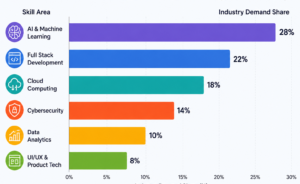
One clear pattern is emerging from these trends: adaptability matters more than static knowledge.
Students who continue learning modern technologies alongside their degree often build stronger career opportunities regardless of whether they choose BCA or B.Tech.
Career Direction Trends After BCA and B.Tech
Both courses open doors to strong technology careers, but students often move toward slightly different pathways.
Common Career Paths After BCA
- Software Development
- Web & App Development
- Data Analytics
- UI/UX Development
- MCA & Higher Studies
Common Career Paths After B.Tech
- Software Engineering
- Artificial Intelligence
- Cloud Computing
- Cybersecurity
- System Architecture
- Higher Technical Studies
The difference is not about “good” versus “bad.” It is more about specialization depth and career direction.
BCA vs B.Tech: Which Course Is Better for Different Students?
There is no universally perfect answer. The better course depends on the student’s interests, strengths, learning preference, and career vision.
Choose BCA If:
- You enjoy practical coding
- You want earlier entry into the IT industry
- You prefer application-oriented learning
- You want flexibility with certifications and future specializations
- You are comfortable building skills independently
Choose B.Tech If:
- You enjoy mathematics and analytical thinking
- You want engineering-level technical depth
- You are interested in advanced systems or research
- You want broader technical exposure
- You prefer structured engineering education
The smartest decision is not choosing the “popular” course. It is choosing the course that aligns with how you learn and where you want to grow professionally.
What Companies Actually Care About Today
One of the biggest misconceptions among students is that companies only care about the degree title.
That is no longer entirely true.
Modern recruiters increasingly evaluate:
- Real coding ability
- GitHub projects
- Internship experience
- AI tool familiarity
- Communication skills
- Problem-solving approach
- Adaptability to new technologies
A student with strong practical exposure and consistent skill development often stands out more than someone who only depends on academic credentials.
This is especially true in software development, AI, cybersecurity, and startup ecosystems.
Career Opportunities After BCA vs B.Tech
| After BCA | After B.Tech |
| Web Developer | Software Engineer |
| App Developer | AI Engineer |
| Software Tester | Systems Engineer |
| UI/UX Developer | Cloud Engineer |
| Data Analyst | Cybersecurity Specialist |
Career growth in both fields depends heavily on continuous learning, project work, networking, and practical exposure.
Salary Comparison in the AI Era
Salary expectations vary depending on skills, location, internships, projects, and specialization.
However, general industry trends often look like this:
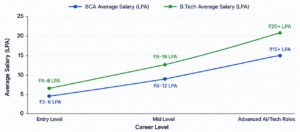
It is important to understand that salary growth today is strongly linked to:
- Technical expertise
- Certifications
- Problem-solving skills
- AI familiarity
- Real-world project experience
- Communication and adaptability
not only the degree itself.
How IT Careers Are Evolving in the AI Era
The traditional career model is changing rapidly.
Earlier, students relied mainly on degrees for career growth. Today, the progression often looks different:
Degree → Skills → Projects → AI Tools → Industry Experience → Career Growth
This shift explains why students who continuously upskill themselves are often able to create stronger opportunities even in highly competitive markets.
Choosing the Right College for IT Courses
The quality of the institution also plays a major role in shaping career outcomes.
While evaluating colleges for BCA or B.Tech, students should consider:
- Updated industry-focused curriculum
- AI and emerging technology exposure
- Coding culture and hackathons
- Internship opportunities
- Faculty mentorship
- Industry collaborations
- Placement ecosystem
- Practical project exposure
Students today often look for institutions that combine technical learning with practical industry exposure. Colleges that focus on project-based learning, coding practice, and emerging technologies can help students become more industry-ready in rapidly evolving IT careers.
Frequently Asked Questions
Is BCA better than B.Tech for software development?
BCA can be excellent for software development because of its practical coding focus. However, B.Tech offers broader technical depth. Both can lead to successful software careers with strong skills.
Can BCA students work in AI fields?
Yes. Many BCA students enter AI-related roles after learning machine learning, Python, data analytics, and AI tools through certifications and projects.
Which course offers higher salary potential?
B.Tech graduates may receive higher starting salaries in some technical roles. However, long-term salary growth depends more on skills and experience.
Is B.Tech still valuable in the AI era?
Absolutely. B.Tech continues to provide strong technical foundations valuable in AI, cloud computing, cybersecurity, and advanced engineering fields.
Can commerce students build IT careers through BCA?
Yes. BCA is one of the most popular pathways for commerce and arts students entering the technology industry.
Is MCA necessary after BCA?
Not always. Some students secure strong jobs after BCA itself, while others pursue MCA for advanced specialization and broader opportunities.
Conclusion
Choosing between BCA and B.Tech is not about finding a universally superior degree. It is about selecting the learning path that matches your interests, strengths, and long-term career goals.
In today’s AI-driven technology industry, practical skills matter more than ever before.
Students who continuously learn, build projects, explore emerging technologies, and adapt to industry changes will create stronger opportunities regardless of the degree they choose.
The future of IT careers will belong not only to degree holders, but to individuals who know how to combine technology, adaptability, creativity, and real-world problem-solving effectively.