
A Bachelor of Arts (BA) is a three-year undergraduate degree four years under India’s NEP framework at many institutions covering humanities, social science, and arts-based subjects like Economics, Psychology, English, and History. Is it a good career choice in 2026? Yes, for students who choose a specialization with real demand and pair it with practical skills, since BA graduates today move into government services, corporate roles, media, education, and several digital-first careers that barely existed a decade ago.
What Is a BA Degree?
BA stands for Bachelor of Arts an undergraduate degree built around developing analytical thinking, communication, and research ability rather than training students for one narrow job role, the way a technical degree like BTech does. People sometimes read that openness as a drawback, but it’s actually what keeps a BA graduate’s options open instead of tying them to one fixed job role. The trade-off is that the degree’s value depends heavily on the subjects chosen and the skills built alongside coursework.
BA Course Structure and Duration
Most BA programs run three years across six semesters, though many colleges now follow NEP’s four-year format with multiple exit points. Year one covers foundation courses and general electives; year two narrows toward the chosen major along with skill-enhancement courses; the final year(s) focus on advanced, specialization-heavy coursework, often including a research project or internship. Continuous internal assessments alongside semester exams are standard.
Popular BA Specializations
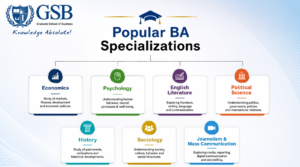
- Economics – banking, finance, policy research, further study in analytics
- Psychology – counseling, HR, market research
- English Literature – content writing, editing, teaching, publishing
- Political Science – civil services, law, journalism, public policy
- History – research roles, civil services, teaching
- Sociology – social work, NGOs, HR, public policy
- Journalism & Mass Communication – media, digital content, corporate communications
The specialization chosen influences career outcomes far more than the degree title itself.
Explore: BA Subjects & Specializations
BA Eligibility and Admission Process
Eligibility is straightforward: candidates need to have passed Class 12 (any stream) from a recognized board, with some colleges setting a minimum aggregate or, occasionally, an entrance test. Admissions generally follow application submission, document verification, merit list or entrance result, and fee payment. Students exploring options will find colleges like GSB offer BA programs with a reasonable spread of specializations, worth comparing against your own subject interests before applying.
Is BA a Good Career Choice in 2026?
It depends on what you do with it but the degree itself is far from outdated. Hiring across corporate, government, and even tech-adjacent roles has shifted toward skills-based assessment, and communication, critical thinking, and adaptability exactly what a BA builds now show up explicitly in job requirements, not just as nice-to-haves.
NEP’s multidisciplinary structure also means today’s BA students aren’t locked into a rigid subject list: an Economics major can add a data analysis elective, a Political Science major can pick up a digital media course. That makes a 2026 BA graduate’s skill set noticeably broader than it would have been five years ago.
The catch: a BA alone, without internships, certifications, or project experience, will underperform compared to more specialized degrees on pure job-readiness. The degree provides the foundation; students who stack practical skills on top of it consistently see better outcomes than those who don’t. So yes, BA is a strong choice in 2026 for students who pick a relevant specialization and put in the extra effort, not for those expecting the title alone to do the work.
Career Options After BA
Government: Civil services (UPSC, state PSCs), banking and SSC exams, teaching (with B.Ed), PSU administrative roles.
Explore: Top Government Job Opportunities After BA
Private Sector: HR and talent management, marketing and market research, content writing and editorial roles, journalism, sales, corporate communications.
Higher Studies: MA in the same or related field, MBA, LLB, mass communication postgraduate programs, civil services preparation.
Emerging/Digital Roles: UX writing, content strategy, social media management, research/data-storytelling roles (especially for Economics-leaning BAs), customer experience and community management.
That’s the real advantage of choosing BA: it doesn’t lock you into one outcome, so the same degree can support a civil services attempt, a marketing career, or a path into law.
BA Salary Expectations in 2026
Salary varies significantly by sector, specialization, and added skills, so treat any single figure with caution. Entry-level private sector roles (content, marketing, HR support) typically start modest but scale quickly with demonstrated skill. Government positions tend to come with predictable salary growth and stronger job security, though clearing the required exams isn’t quick. Roles requiring a postgraduate qualification (MBA, LLB) command noticeably higher starting pay than a BA alone. Across the board, graduates who add a certification or internship to their BA report better starting compensation than those who don’t.
BA vs BSc vs BCom Which one Should You Choose?
| BA | BSc | BCom | |
|---|---|---|---|
| Focus | Humanities, social sciences | Pure/applied sciences | Commerce, accounting |
| Subjects | Economics, Psychology, History, English | Physics, Chemistry, Computer Science | Accounting, Finance, Business Law |
| Career Paths | Civil services, media, HR, teaching, law | Research, IT, technical fields | Banking, finance, accounting |
| Best For | Communication and analysis-oriented students | Technical, lab-based interests | Finance and business-focused students |
No single option is universally better the right pick depends on the career direction already in mind.
Frequently Asked Questions
Is BA a good degree in 2026? Yes, for students who choose a relevant specialization and build practical skills alongside coursework.
What is the scope of BA after graduation? Government services, private sector roles in HR/marketing/content, higher studies like MA or MBA, and emerging digital-first careers.
Can I do an MBA after BA? Yes it’s a common path, and most MBA programs accept students from any undergraduate background.
Which BA specialization has the best career scope? Economics, Psychology, and Political Science offer the widest range, though the best choice depends on individual interest and goals.
What is the average salary after BA? It varies by sector and specialization; government roles offer steadier long-term pay, while private roles often scale faster with added skills.
Final Thoughts
A BA in 2026 isn’t a fallback degree it’s a flexible one, and that flexibility rewards students who use it deliberately. Choosing a relevant specialization, building practical skills alongside coursework, and being intentional about the path after graduation matter far more than the degree title. Anyone weighing their options is best served by speaking with an academic counselor who can map a specialization to their actual career goals.