Completing a Bachelor of Computer Applications (BCA) is an important milestone, but it often leads to a bigger question: What should you do next?
The answer depends on your career goals. Some BCA graduates start working immediately, while others pursue higher education or specialize in emerging technologies. In today’s AI-driven world, the smartest path is not necessarily collecting more degrees; it’s building skills that match industry demand.
If you’re wondering what to do after BCA, this guide will help you understand the most practical career options and choose the right direction.
Quick Answer: What Should You Do After BCA?
| Your Goal | Best Next Step |
| Get a job quickly | Start working and gain experience |
| Become a software developer | Learn Full Stack Development |
| Build a career in AI | Learn AI, Machine Learning, and Python |
| Work with data | Learn Data Analytics and SQL |
| Enter management roles | Pursue an MBA |
| Advance technical expertise | Pursue MCA |
| Build a cybersecurity career | Learn Ethical Hacking and Security Tools |
| Work in cloud technologies | Learn AWS, Azure, or Google Cloud |
The best choice depends on your interests, strengths, and long-term career plans.
Is BCA Still Worth It in the AI Era?
Yes.
Artificial Intelligence is transforming the technology industry, but it is not replacing skilled professionals. Instead, it is changing the tools and workflows people use.
Companies still need developers, analysts, cybersecurity professionals, cloud engineers, and IT specialists. The difference is that employers increasingly expect candidates to understand modern technologies and AI-powered tools.
A BCA degree provides a strong foundation in programming, databases, networking, and software development. Students who combine that foundation with practical skills remain highly employable.
Key Takeaway: AI is changing how technology professionals work, not eliminating the need for them.
The 5 Best Career Paths After BCA
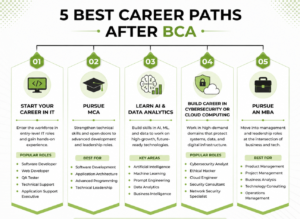
1. Start Your Career in IT
Many BCA graduates choose to enter the workforce immediately.
Popular entry-level roles include:
- Software Developer
- Web Developer
- Technical Support Engineer
- QA Tester
- Application Support Executive
This option is ideal for students who want practical experience and financial independence early in their careers.
2. Pursue MCA
Master of Computer Applications (MCA) remains one of the most popular options after BCA.
An MCA program helps students strengthen their technical expertise and can open doors to advanced software development, system design, and technical leadership roles.
Best for:
- Software Development
- Application Architecture
- Advanced Programming Careers
3. Learn AI and Data Analytics
AI is influencing nearly every industry, making it one of the most promising career directions for technology graduates.
Areas worth exploring include:
- Artificial Intelligence
- Machine Learning
- Prompt Engineering
- Data Analytics
- Business Intelligence
Students with strong analytical thinking and programming skills often perform well in these fields.
4. Build a Career in Cybersecurity or Cloud Computing
The rapid adoption of digital technologies has made cybersecurity and cloud computing essential areas for modern organizations.
Career options include:
- Cybersecurity Analyst
- Ethical Hacker
- Cloud Engineer
- Security Consultant
- Network Security Specialist
These fields continue to show strong demand across industries.
5. Pursue an MBA
Not every BCA graduate wants to stay in a purely technical role.
An MBA can help students transition into:
- Product Management
- Project Management
- Business Analysis
- Technology Consulting
- Operations Management
This option is particularly valuable for students interested in leadership and business-oriented careers.
Explore: Is MBA Only for Business Students?
Most In-Demand Skills for BCA Graduates in 2026
Technology changes quickly, but some skills consistently remain valuable.
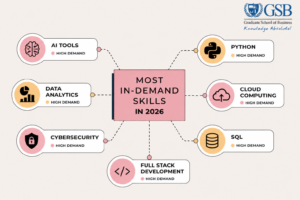
Instead of trying to learn everything at once, focus on one or two areas and build practical projects around them.
Employers often value demonstrable skills more than certificates alone.
Which Path Offers the Best Career Growth?
| Option | Time Required | Career Growth Potential |
| Job After BCA | Low | Good |
| MCA | Medium | Very Good |
| MBA | Medium | Good |
| AI & Data Analytics | Low-Medium | Excellent |
| Cybersecurity | Low-Medium | Excellent |
| Cloud Computing | Low-Medium | Excellent |
Students who combine experience with specialized skills generally see the strongest long-term growth.
Explore: Best MBA Career Opportunities Beyond Corporate Jobs
My Recommendation for BCA Students
If you’re unsure about your next step, don’t rush into another degree simply because everyone else is doing it.
First, identify what interests you most.
If you enjoy programming, consider full stack development, AI, or cloud computing. If you enjoy solving business problems, data analytics may be a strong option. If leadership interests you, an MBA could be the right path.
In today’s job market, practical skills, internships, projects, and real-world experience often matter just as much as formal qualifications.
Frequently Asked Questions
What is the best career option after BCA?
There is no single best option. AI, Data Analytics, Cybersecurity, Full Stack Development, MCA, and MBA are among the most popular choices.
Is MCA better than MBA after BCA?
MCA is generally better for technical careers, while MBA is better for management and business-focused roles.
Can I get a job directly after BCA?
Yes. Many graduates secure entry-level roles in software development, web development, technical support, and testing.
Is AI a good career option after BCA?
Yes. AI-related roles continue to grow, and BCA graduates with strong programming and analytical skills can build successful careers in this field.
Which skills should BCA students learn in 2026?
Python, AI tools, Data Analytics, SQL, Cloud Computing, Cybersecurity, and Full Stack Development are among the most valuable skills.
Final Thoughts
The best path after BCA depends on your career goals, not on what everyone else is doing. Some students benefit from pursuing MCA or MBA, while others find success through specialized skills in AI, cybersecurity, cloud computing, or data analytics.
The good news is that technology careers continue to evolve, creating new opportunities for those willing to learn and adapt. Focus on building practical skills, gaining experience, and staying curious. In the AI era, continuous learning is often the biggest advantage you can have.
Institutions like GSB College help students complement academic learning with practical skills and industry exposure.